


Photo by Markus Spiske on Unsplash
At a certain level of growth, people stop asking how to succeed and start asking a quieter, more unsettling question:
“Why does connection still feel hard—even when everything else is working?”
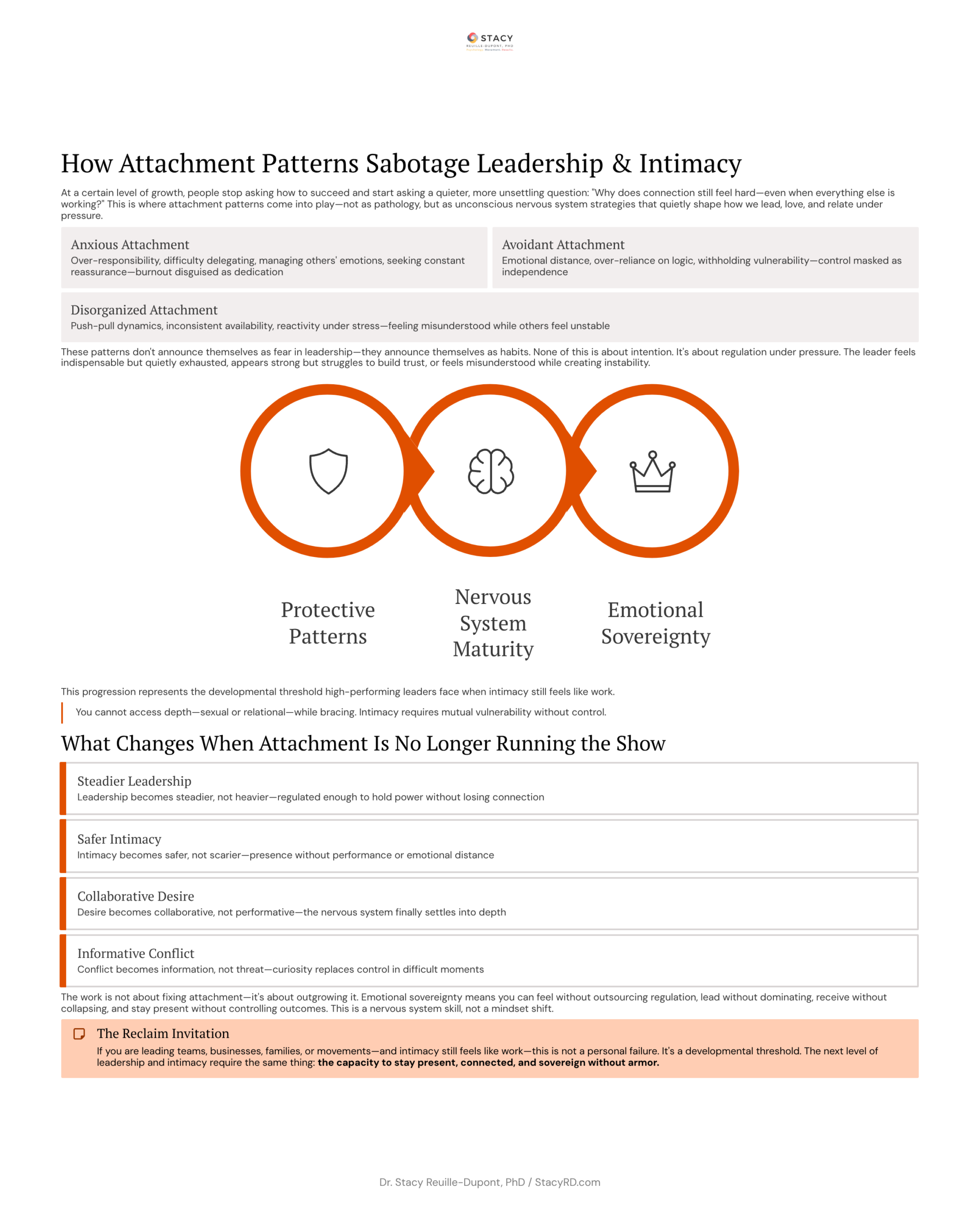
This is where attachment patterns come into play.
Not as pathology.
Not as pop-psych labels.
But as unconscious nervous system strategies that quietly shape how we lead, love, and relate under pressure.
For high-performing people, attachment patterns don’t usually show up as chaos.
They show up as invisible friction—missed intimacy, leadership breakdowns, and relationships that stall just below depth.
Attachment Patterns Are Not Personality Traits
They’re Survival Strategies
Attachment patterns form early as the nervous system learns one core lesson:
“What do I have to do to stay connected and safe?”
That learning doesn’t disappear when you become successful, insightful, or emotionally intelligent.
It simply becomes more sophisticated.
Which is why attachment patterns are often hardest to see in capable adults.
They don’t look like insecurity.
They look like style.
How Attachment Sabotage Shows Up in Leadership
In leadership, attachment patterns don’t announce themselves as fear.
They announce themselves as habits.
Anxious Attachment in Leadership
Often appears as:
-
Over-responsibility
-
Difficulty delegating
-
Managing others’ emotions
-
Seeking constant feedback or reassurance
-
Burnout disguised as dedication
The leader feels indispensable—but quietly exhausted.
Avoidant Attachment in Leadership
Often appears as:
-
Emotional distance
-
Over-reliance on logic
-
Withholding vulnerability
-
Discomfort with collaboration
-
Control masked as independence
The leader appears strong—but struggles to build trust.
Disorganized Attachment in Leadership
Often appears as:
-
Push–pull dynamics
-
Inconsistent availability
-
Reactivity under stress
-
Difficulty sustaining teams or partnerships
The leader feels misunderstood—while others feel unstable around them.
None of this is about intention.
It’s about regulation under pressure.
The Intimacy Cost Leaders Rarely Talk About
What makes this especially painful is that many leaders are deeply capable in public—and quietly lonely in private.
Attachment patterns that are rewarded professionally often undermine intimacy.
-
The self-sufficient leader struggles to receive care
-
The high-achiever confuses effort with connection
-
The emotionally contained leader avoids conflict—and depth
-
The hyper-responsible partner becomes resentful
Intimacy requires something leadership rarely demands:
Mutual vulnerability without control.
And if your nervous system learned early that vulnerability equals danger, intimacy will always feel risky—no matter how much you want it.
Why Attachment Patterns Block Nervous System Coherence
Leadership and intimacy both rely on the same foundation:
Co-regulation.
The ability to stay present, grounded, and responsive while another person is emotional, uncertain, or different from you.
When attachment patterns are running the show:
-
The nervous system defaults to protection
-
Power becomes a shield
-
Control replaces curiosity
-
Connection becomes conditional
This destroys coherence—the state where two systems can think, feel, and create together.
And without coherence:
-
Innovation collapses
-
Creativity stalls
-
Sexual connection dulls
-
Teams fracture
-
Partnerships feel heavy instead of generative
The Link Between Attachment & Sexual Intimacy
Sexual intimacy is often where attachment patterns become unavoidable.
Because sexuality requires:
-
Presence
-
Surrender
-
Mutual attunement
-
Safety without performance
Attachment sabotage shows up as:
-
Distraction during intimacy
-
Performance pressure
-
Emotional distance
-
Desire mismatch
-
Avoidance masked as independence
Not because desire is gone—but because the nervous system never fully settles.
You cannot access depth—sexual or relational—while bracing.
Reclaiming Leadership Through Emotional Sovereignty
The work is not about fixing attachment.
It’s about outgrowing it.
Emotional sovereignty means:
-
You can feel without outsourcing regulation
-
You can lead without dominating
-
You can receive without collapsing
-
You can stay present without controlling outcomes
This is a nervous system skill—not a mindset shift.
It’s the ability to notice:
-
When you’re managing instead of relating
-
When you’re performing instead of connecting
-
When power is being used to avoid vulnerability
And to choose differently.
What Changes When Attachment Is No Longer Running the Show
When attachment patterns loosen their grip:
-
Leadership becomes steadier, not heavier
-
Intimacy becomes safer, not scarier
-
Desire becomes collaborative, not performative
-
Conflict becomes information, not threat
-
Relationships become places of restoration
This is not about becoming softer or less powerful.
It’s about becoming regulated enough to hold power without losing connection.
The Reclaim Invitation
If you are leading teams, businesses, families, or movements—and intimacy still feels like work—this is not a personal failure.
It’s a developmental threshold.
You are being asked to lead from a regulated nervous system, not a protective one.
Because the next level of leadership—
and the next level of intimacy—
require the same thing:
The capacity to stay present, connected, and sovereign
without armor.
And that is a skill worth reclaiming.
#EmbodiedLeadership #AttachmentHealing #NervousSystemHealth #EmotionalSovereignty #LeadershipAndIntimacy #HighAchievers #RelationalIntelligence #TraumaInformedLeadership #PersonalDevelopment

 Twitter
 Facebook
 Linkedin